


You can add any HTML here
We suggest you to create a Saved Template in Dashboard -> Templates -> Saved Templates and use it by switching content type above to Saved template.
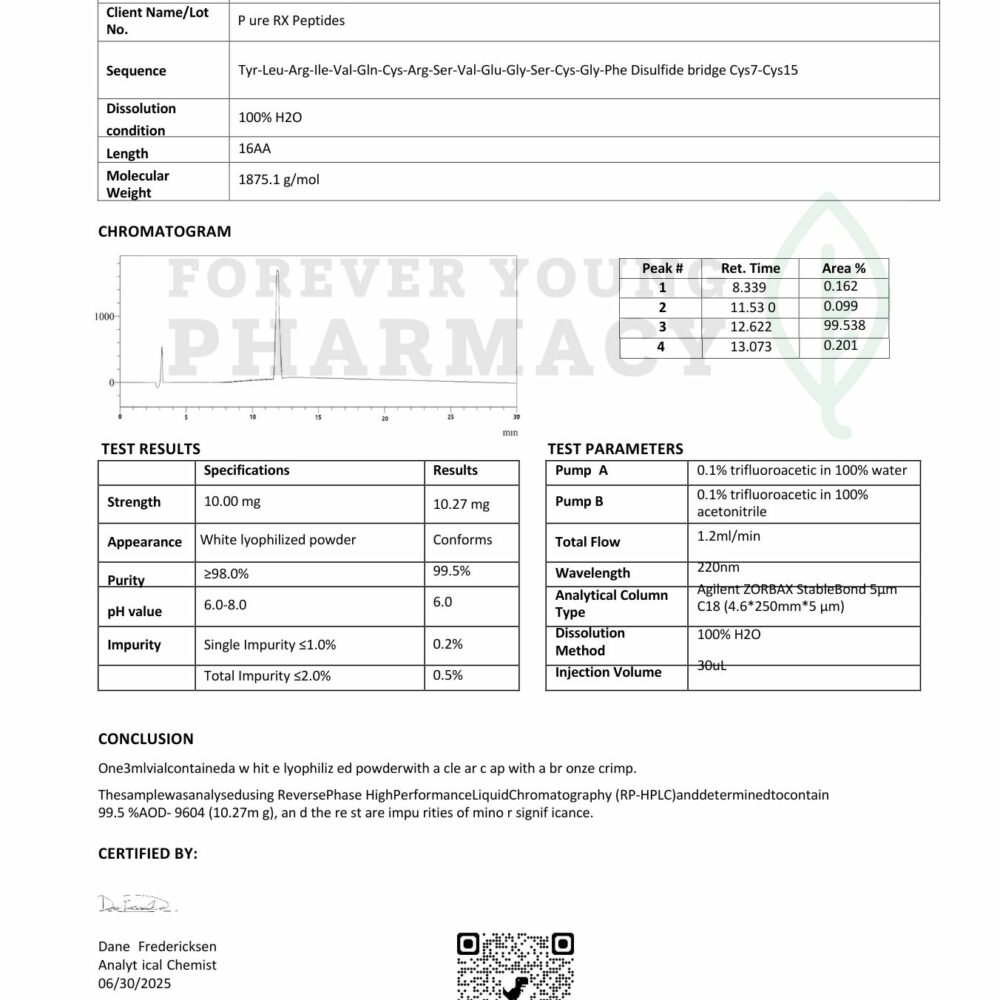
AOD 9604
- Form: Lyophilized powder
- Purity: >99%
Overview
AOD 9604 is a synthetic analog of human growth hormone (hGH), specifically derived from the C-terminal fragment 176–191. This modified peptide was developed to investigate potential anti-obesity properties without stimulating Insulin-like Growth Factor 1 (IGF-1) production. Researchers often refer to it as GH Fragment 176-191 or simply AOD 9604. To improve stability, the peptide includes a tyrosine substitution at the N-terminus.
Research Background
AOD 9604 is considered the lipolytic fragment of hGH. Different regions of hGH display distinct biological actions:
- The N-terminal region has been associated with insulin-potentiating effects.
- Amino acids 108–129 appear to show high mitogenic activity.
- The 176–191 fragment has been linked to lipolysis and fat metabolism.
Developed in the 1990s, AOD 9604 was designed to explore selective fat-reducing effects of growth hormone while minimizing undesired anabolic or mitogenic actions.
Mechanism of Interest
- Lipolysis: the breakdown of stored triglycerides into glycerol and free fatty acids.
- Beta-adrenergic receptors (β3-AR): animal studies indicate increased RNA expression of β3-AR in fat cells following exposure to AOD 9604, which may enhance receptor sensitivity to lipolytic stimuli.
- Non-IGF pathways: unlike full-length hGH, AOD 9604 appears to act independently of IGF-1 stimulation.
The exact mechanism remains under study. AOD 9604 is consistently investigated for its potential role in fat metabolism and weight regulation.
Molecular Information
- Molecular Formula: C78H123N23O23S2
- Molecular Weight: 1815.12 g/mol
- Other Names: Tyr-hGH Fragment 177–191
AOD-9604 10mg
$28.00
AOD-9604 10mg | AOD-9604 10mg is a synthetic peptide fragment of human growth hormone researched for fat metabolism, cartilage repair, and weight management applications.
AOD 9604
- Form: Lyophilized powder
- Purity: >99%
Overview
AOD 9604 is a synthetic analog of human growth hormone (hGH), specifically derived from the C-terminal fragment 176–191. This modified peptide was developed to investigate potential anti-obesity properties without stimulating Insulin-like Growth Factor 1 (IGF-1) production. Researchers often refer to it as GH Fragment 176-191 or simply AOD 9604. To improve stability, the peptide includes a tyrosine substitution at the N-terminus.
Research Background
AOD 9604 is considered the lipolytic fragment of hGH. Different regions of hGH display distinct biological actions:
- The N-terminal region has been associated with insulin-potentiating effects.
- Amino acids 108–129 appear to show high mitogenic activity.
- The 176–191 fragment has been linked to lipolysis and fat metabolism.
Developed in the 1990s, AOD 9604 was designed to explore selective fat-reducing effects of growth hormone while minimizing undesired anabolic or mitogenic actions.
Mechanism of Interest
- Lipolysis: the breakdown of stored triglycerides into glycerol and free fatty acids.
- Beta-adrenergic receptors (β3-AR): animal studies indicate increased RNA expression of β3-AR in fat cells following exposure to AOD 9604, which may enhance receptor sensitivity to lipolytic stimuli.
- Non-IGF pathways: unlike full-length hGH, AOD 9604 appears to act independently of IGF-1 stimulation.
The exact mechanism remains under study. AOD 9604 is consistently investigated for its potential role in fat metabolism and weight regulation.
Molecular Information
- Molecular Formula: C78H123N23O23S2
- Molecular Weight: 1815.12 g/mol
- Other Names: Tyr-hGH Fragment 177–191
In stock
- Free shipping on all orders above $175
- Super Fast Shipping!
- Packaging doubles as storage container.
Related products


 AOD-9604 10mg
$28.00
In stock